language
  русский
 عربى
عربى Indonesia
Home / Blog / Industry News / Why Is Your Horizontal Centrifugal Pump Losing Efficiency? 7 Factors That Kill Your Performance
News


 2026.02.23
 Industry News
The Horizontal Centrifugal Pump is one of the most widely used pieces of mechanical equipment in the global industrial sector. From municipal water supply systems to complex oil refineries, this pump has become the heart of fluid transport due to its simple structure, ease of maintenance, and stable flow characteristics.
The operation of a Horizontal Centrifugal Pump is based on the principle of centrifugal force. When the motor drives the pump shaft, the impeller mounted on the shaft rotates at high speeds. Fluid enters the center of the impeller (the eye) from the pump's suction inlet and is pushed by the rotating impeller vanes, gaining significant kinetic energy and centrifugal force.
Subsequently, the fluid is thrown toward the outer edge of the impeller and enters the pump casing (usually a volute design). During this process, the high-speed kinetic energy of the fluid is converted into pressure energy (static pressure). Since the axis is distributed horizontally, the fluid inlet and outlet are usually located on the same horizontal plane or at a 90-degree angle. This physical layout not only lowers the center of gravity but also greatly simplifies the installation and foundation construction of large pump sets.
To deeply understand the efficiency of a Horizontal Centrifugal Pump, one must analyze its key components and their functions:
Impeller: The soul of the pump. Its vane angle, quantity, and surface smoothness directly determine the efficiency of energy conversion.
Volute: The involute-style flow passage design is responsible for collecting the high-speed liquid thrown from the impeller and decelerating it smoothly to convert kinetic energy into pressure energy.
Sealing System: Usually employing mechanical seals or packing seals to prevent fluid leakage or external air entry. Its friction loss is key to mechanical efficiency.
Bearings & Bracket: Support the horizontally rotating shaft system, ensuring dynamic balance during operation.
When evaluating the performance of a Horizontal Centrifugal Pump, efficiency is not a single value but the cumulative result of multiple energy conversion processes.
The total efficiency of a Horizontal Centrifugal Pump can be expressed by the following logic: Total Efficiency = Hydraulic Efficiency × Volumetric Efficiency × Mechanical Efficiency.
Hydraulic Efficiency: Measures energy loss due to friction, impact, and turbulence as fluid passes through the impeller and volute. This is the core indicator determining the performance upper limit.
Volumetric Efficiency: Measures internal leakage. Since a gap must exist between the impeller wear ring and the pump body, some pressurized fluid flows back to the suction end, reducing volumetric efficiency.
Mechanical Efficiency: Covers bearing friction, seal friction, and disc friction losses as the impeller rotates in the fluid.
Every Horizontal Centrifugal Pump has a performance curve (P-Q Curve) from the factory. The efficiency curve is parabolic, and the highest point is the BEP.
Cost of Deviating from BEP: When a pump operates away from its design point (e.g., flow rate too high or too low), the angle at which fluid enters the impeller becomes misaligned, creating severe hydraulic impact and turbulence, leading to a sharp drop in efficiency accompanied by vibration and noise.
| Parameter Category | Low Efficiency Range | High Efficiency Range (BEP) | Impact Result |
| Flow Rate | Less than 50% or over 120% of rated | 85% - 105% of rated | Deviation leads to sharp hydraulic losses |
| Fluid Viscosity | High viscosity (over 100 cSt) | Low viscosity (e.g., Water) | Higher viscosity increases disc friction |
| Speed | Too low (below design limit) | Rated speed (with VFD) | Power varies with the cube of the speed |
| Surface Roughness | Raw cast iron surface | Polished or coated surface | Roughness directly lowers hydraulic efficiency |
| Clearance Control | Large wear ring gap | Tight precision clearance | Increased gap significantly drops volumetric efficiency |
The hydraulic design of a Horizontal Centrifugal Pump determines its physical limits. Modern pump manufacturing utilizes CFD (Computational Fluid Dynamics) to simulate every streamline within the impeller.
Vane Shape: Backward-curved vanes usually provide higher efficiency and a more stable pressure curve.
Outlet Width: The width of the impeller outlet must precisely match the throat area of the volute, otherwise severe secondary flow losses occur.
In a Horizontal Centrifugal Pump, while mechanical losses are smaller than hydraulic losses, they cannot be ignored in high-speed applications.
Mechanical Seals: Modern dry gas seals or balanced mechanical seals significantly reduce friction power consumption compared to traditional packing.
Disc Friction: When the impeller rotates in a fluid-filled chamber, friction between the impeller shroud and the liquid consumes power. Trimming the impeller diameter can change the proportion of disc friction.
Efficient Horizontal Centrifugal Pumps often feature high-quality flow passage surfaces. Through precision casting or post-spraying of high-molecular ceramic coatings, the internal pump chamber can reach extremely low roughness. This reduces viscous resistance and enhances corrosion resistance, ensuring the pump maintains its initial efficiency for years.
The design of the Horizontal Centrifugal Pump is not uniform. Depending on industrial needs such as extreme pressure or massive flow, its structure changes significantly.
Single-Stage Horizontal Centrifugal Pump: Contains only one impeller. These are compact and suitable for high flow, low or medium head conditions like cooling water systems.
Multi-Stage Horizontal Centrifugal Pump: Several impellers are connected in series on a horizontal shaft. Pressure adds up at each stage. This design excels in boiler feed water or mine drainage, providing high head at lower flow rates.
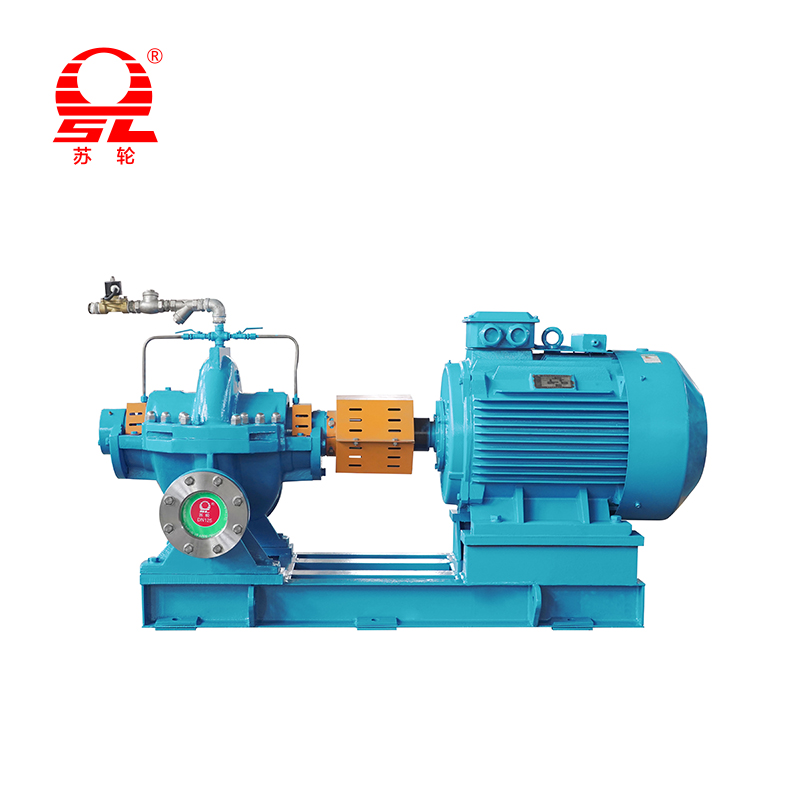
These are the two most common configurations for a Horizontal Centrifugal Pump, with varying efficiency limits and maintenance benefits:
| Feature Parameter | End Suction | Split Case |
| Typical Flow Range | Less than 250 cubic meters/hour | Greater than 500 cubic meters/hour |
| Max Efficiency | 70% - 82% | 85% - 91% |
| Impeller Type | Single Suction | Double Suction |
| NPSHr Performance | Higher (High suction pressure req.) | Lower (Double suction reduces velocity) |
| Maintenance | Requires moving motor/pipes | Open top casing for easy access |
Even a highly efficient Horizontal Centrifugal Pump will perform poorly if installed in an improperly designed piping system. Engineers focus on Wire-to-Water total system efficiency.
Traditional Horizontal Centrifugal Pumps rely on throttling valves to adjust flow, which essentially wastes energy by increasing system resistance. By introducing a VFD:
Affinity Laws: When pump speed drops by 10%, flow drops by 10%, but energy consumption drops by approximately 27%.
Soft Start: VFDs allow the pump to start smoothly, eliminating water hammer impacts and extending seal life.
The installation position directly affects the efficiency of a Horizontal Centrifugal Pump.
Suction Design: The straight pipe section before the suction inlet should be at least 5 to 10 times the pipe diameter. Sharp bends cause vortices before fluid enters the impeller, inducing cavitation.
NPSH Matching: The Net Positive Suction Head available (NPSHa) must always be higher than the Net Positive Suction Head required (NPSHr). Imbalance causes vapor bubbles to collapse and erode the impeller metal.
Maintenance is not just about fixing when broken but about managing the factory efficiency of the Horizontal Centrifugal Pump.
When a Horizontal Centrifugal Pump is found to have excess power for its application, machining the impeller to a slightly smaller diameter is a common energy-saving method. This is much more efficient than partially closing an outlet valve.
| Monitoring Item | Abnormal Performance | Impact on Efficiency |
| Vibration | Greater than 4.5 mm/s | Mechanical efficiency drops, seal life halved |
| Bearing Temp | Greater than 80 degrees Celsius | Increased friction, lubrication failure |
| Pressure Fluctuation | Intermittent pressure drops | Possible internal recirculation or cavitation |
| Seal Leakage | From dripping to spraying | Sharp drop in volumetric efficiency |
For a Horizontal Centrifugal Pump, perfect alignment between the pump shaft and motor shaft is vital. Even a 0.1mm deviation creates massive radial forces, wasting energy as heat in the bearings. Laser alignment tools ensure over 95% of electrical energy is converted into mechanical work.
In practice, the Horizontal Centrifugal Pump is customized based on environmental needs:
Municipal Water Supply: Large split-case pumps are used for high BEP operational stability.
Chemical Processing: Focuses on corrosion-resistant materials (e.g., stainless steel or Hastelloy) to prevent roughness increases due to corrosion.
Firefighting: Emphasizes instantaneous startup reliability and stability under high pressure.
Manuals provide peak efficiency under ideal laboratory conditions. In practice, pipe resistance calculation errors, fluid impurities, viscosity changes, and internal wear (like increased wear ring gaps) cause efficiency to decline.
When you find that outlet pressure has dropped by more than 10% and energy consumption has risen at the same frequency/speed, it usually means internal balance discs or wear rings have failed.
Given the same hydraulic model, their efficiencies are comparable. However, a Horizontal Centrifugal Pump has a lower center of gravity and less vibration. In large flow applications, horizontal split-case double-suction structures are generally more efficient than single-suction vertical pumps.
No. Every Horizontal Centrifugal Pump has a minimum continuous stable flow limit. Too low a frequency can cause fluid overheating, recirculation, and axial force imbalance.

+86-0523- 84351 090 /+86-180 0142 8659


Add 1: Hongguang Industrial Park, Jingjiang City, Jiangsu Province, China
Add 2: No.68, Xinyi Road, Industrial Park, Jingjiang City, Jiangsu Province, China
+86-0523- 84351 090
+86-180 0142 8659
+0523-8435 5588