language
 русский
 عربى
 Indonesia
Home / Blog / Industry News / Submersible vs Self-Priming Sewage Pumps: Industrial Pros, Cons, and Selection Guide
News


 2026.11.09
 Industry News
The quickest way to choose between a submersible sewage pump and a self-priming sewage pump is to read the station layout. If the impeller can sit in the liquid, a submersible pump usually gives the simpler hydraulic path, with flooded suction and no long suction line. If the motor must stay dry and the liquid has to be lifted from a sump, a self-priming pump usually earns its space, even when the suction line and priming chamber add work.
For sewage service, “pros and cons” is not a generic scorecard. The same submersible pump can be excellent in a municipal wet well and awkward in a dry chamber with a long suction pipe. A self-priming pump can be a maintenance-friendly choice in a retrofit and a poor choice where the lift is too high, the suction line leaks air, or the solids are too stringy for the impeller passage. The decision should start with four facts: where the liquid sits, how much lift the layout requires, what solids must pass, and who will service the pump.
Working rule: specify a submersible pump when flooded suction, compact civil works, and high inflow control matter most. Specify a self-priming pump when dry-motor access, suction lift, and easy inspection matter most. Then confirm solids passage, NPSH margin, duty point, and maintenance access before fixing the model.
Use this table as an early screening tool. It is not a substitute for a duty-point calculation, but it shows where the two sewage pump designs create different installation, operating, and service risks.
| Decision factor | Submersible sewage pump | Self-priming sewage pump |
|---|---|---|
| Pump location | Motor and impeller are submerged in the wet well or sump. | Pump sits in a dry chamber or above the wet well; only the suction pipe enters the liquid. |
| Suction condition | Flooded suction by design, so suction lift is normally not part of the pump selection. | Requires a calculated suction lift, air-tight pipework, and reliable priming. |
| Civil works | Compact wet well, guide rails, lifting chain, and access cover are usually enough. | Needs a dry chamber, suction line, foot valve or priming arrangement, and more floor space. |
| Maintenance access | The pump is lifted out of the wet well; seals, cable, and impeller are inspected off-station. | The motor and priming chamber are accessible without entering the wet well. |
| Dry-run risk | Seal faces, cable entry, and motor cooling depend on liquid coverage and protection settings. | The motor stays dry, but the mechanical seal and priming chamber can suffer if the pump runs without liquid. |
| Solids handling | Depends on impeller type: vortex, semi-open, channel, or cutter arrangements. | Depends on impeller and volute passage; trash-handling self-priming models use larger passages and wear-resistant materials. |
| NPSH margin | Usually favorable because the impeller is below the liquid surface. | Must be calculated with suction-line losses, liquid temperature, altitude, and priming conditions. |
| Operating cost | Efficient at high flow when the duty point is close to best efficiency; suction losses are low. | Efficiency depends on suction-line losses, priming time, and whether the pump operates far from its best point. |
A submersible sewage pump places the motor and impeller in the liquid. That single fact drives most of its advantages and most of its service risks. The pump is cooled by the surrounding liquid, the impeller has flooded suction, and the station needs no long suction pipe. The same fact also means that every seal, cable entry, and lifting arrangement is part of the wet-well reliability plan.
For an industrial sewage duty with rags, sand, and variable inflow, the pump selection should start with the volute passage and impeller type, not the motor nameplate. An industrial-grade sewage treatment pump may use a vortex or semi-open impeller to reduce wrapping, but the trade-off is often lower efficiency at the same duty point. The correct choice depends on whether the station is controlled by solids or by flow.
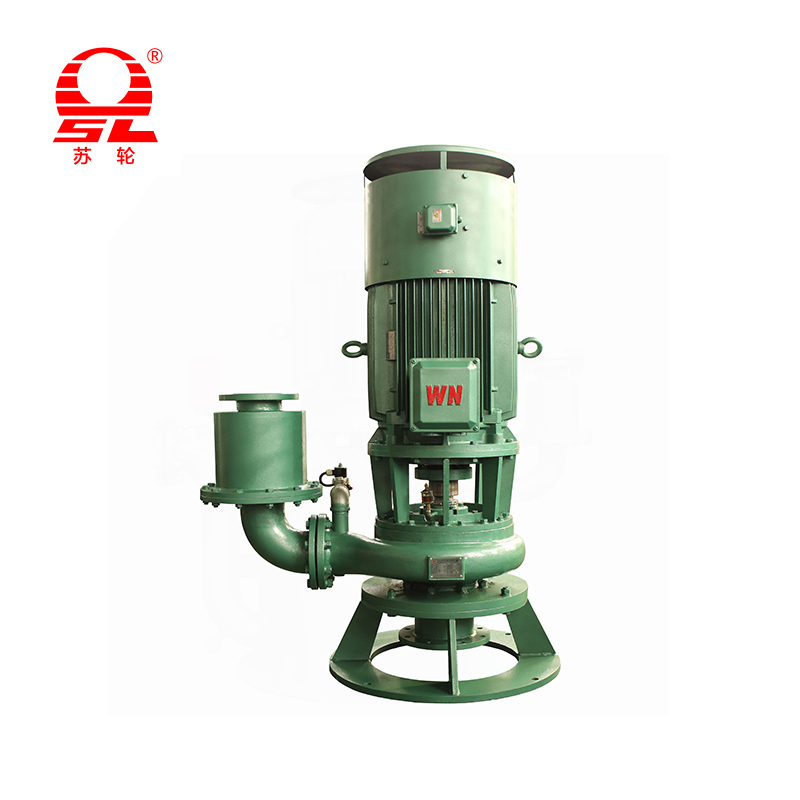
 WQ Series Submersible Sewage Pump for Wet-Well DutyIntegrated motor-and-pump sewage pump for solids and long fibers; its sealing design and installation guidance make it worth checking for wet-well service.View Product →
The WQ series submersible sewage pump is a practical reference point for wet-well service. When reviewing a model, confirm the free passage, head-flow curve, minimum submergence, cable length, seal arrangement, and whether the installation needs a guide rail or a portable coupling. These details decide whether the pump behaves as a compact station solution or becomes a frequent lifting job.
A self-priming sewage pump keeps the motor dry and uses a priming chamber to remove air from the suction line before normal pumping begins. The arrangement is useful when the liquid level is below the pump, when the wet well is deep, or when maintenance access to the motor is a priority. The cost is that the suction line becomes part of the machine: every joint, valve, and gasket can affect priming.
Stringy solids change the impeller choice. A standard self-priming pump may pass a sphere of a given size but still clog on wipes, fiber, or rags. A heavy-duty self-priming trash pump uses a larger passage, a more robust impeller, and wear-resistant materials to handle that risk, but the buyer should still check the actual solids profile rather than relying on a single “solids diameter” number.
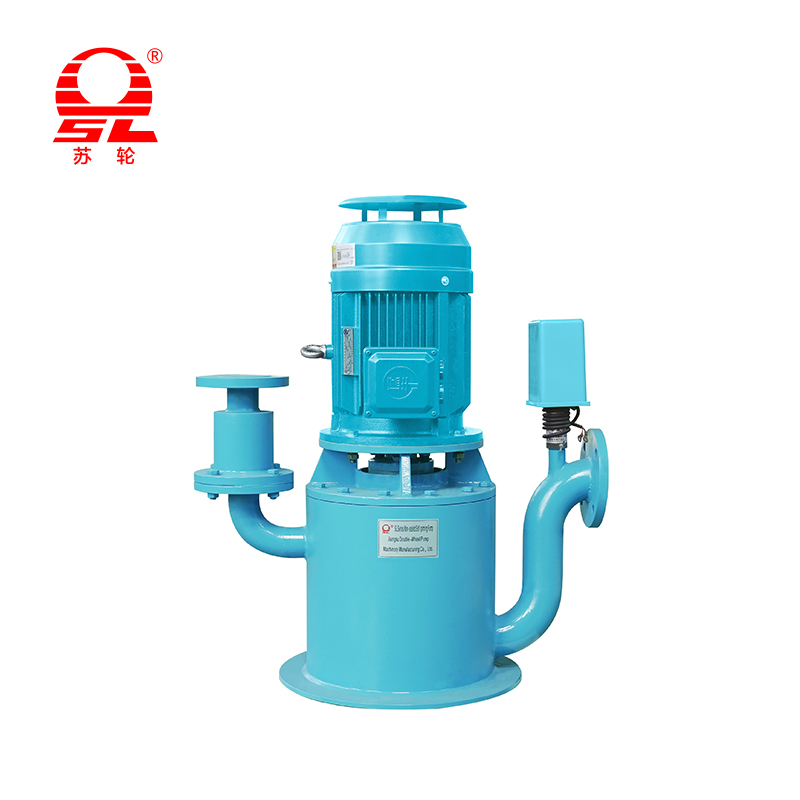
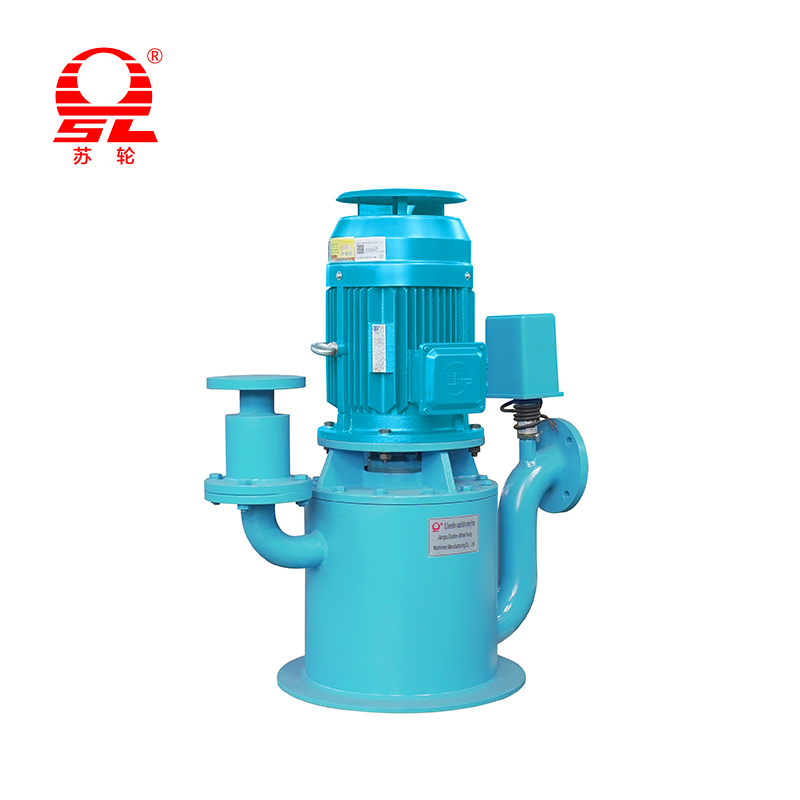 WFB Seal-Free Self-Priming Pump SeriesSeal-free self-priming series with up to 7.0 m lift and multiple materials; useful where dry-motor access and reduced seal exposure matter.View Product →
The WFB sealless self-priming pump is relevant where the process wants dry-motor access and reduced seal exposure. The “sealless” description should not be read as “maintenance-free.” It shifts attention to the priming chamber, the impeller clearance, the suction pipe, and the control logic that prevents dry running. In sewage service, those details often decide reliability more than the pump casing alone.
Two pumps with the same discharge size can behave very differently on the same sewage duty. The difference is usually the impeller and volute passage, not the flange size. A pump rated for a large sphere may still fail on a long wipe. A pump rated for a smaller sphere may run cleanly if the impeller creates a strong sweeping action and the station has good velocity.
Ask for the actual free passage and the shape of the passage. A round opening and a narrow, curved channel can behave differently even when both claim a similar solids diameter.
A vortex impeller creates a swirling flow that reduces wrapping. It is useful for fibrous sewage, but it often uses more energy than a well-matched channel impeller at the same duty point.
Semi-open designs can handle small solids and abrasive silt, but the clearance between impeller and wear plate must be maintained. Wear increases recirculation and reduces head.
Cutter arrangements reduce particle size, but they are not a universal answer. Hard debris, stones, and metal can damage the cutting edges and create a different maintenance profile.
For a sewage station, ask for the solids profile: average size, maximum size, fiber content, grit content, and the presence of sand or gravel. Then ask how the impeller behaves when the pump starts against a partially blocked passage. A pump that can pass a solid while running may still struggle to start after a weekend of low flow and settling.
Submersible and self-priming pumps are often compared on head and flow alone. That comparison is incomplete. A self-priming pump may show a strong curve at the test bench and still underperform on site because the suction line loses more pressure than expected. A submersible pump may show a lower efficiency at the same duty point but deliver more stable output because the impeller is flooded and the suction path is short.
The chart below is a relative screening aid, not a guarantee. It shows why the same duty can produce different risk profiles when the station layout changes.
For a self-priming sewage pump, calculate the suction lift with the liquid at its lowest operating level, not the normal level. Add the suction pipe friction, strainer loss, elbow loss, and any valve loss. Then compare the result with the pump’s NPSH requirement at the maximum expected flow. If the margin is thin, a larger suction pipe or a different station layout can be more effective than a larger pump.
For a submersible pump, confirm minimum submergence and the low-level control. A pump that is hydraulically flooded at normal level can still draw air at low level if the wet well creates a vortex. Baffles, correct stop levels, and proper inflow control are part of the pump selection, not accessories added later.
The purchase price is only the first number. The larger cost often appears in lifting frequency, confined-space work, seal replacement, and production interruption. A submersible station can be compact and cost-effective to build, but it needs a credible plan for lifting a heavy pump out of a wet well. A self-priming station can be easier to inspect, but it needs a dry chamber, a suction line, and a priming system that is maintained.
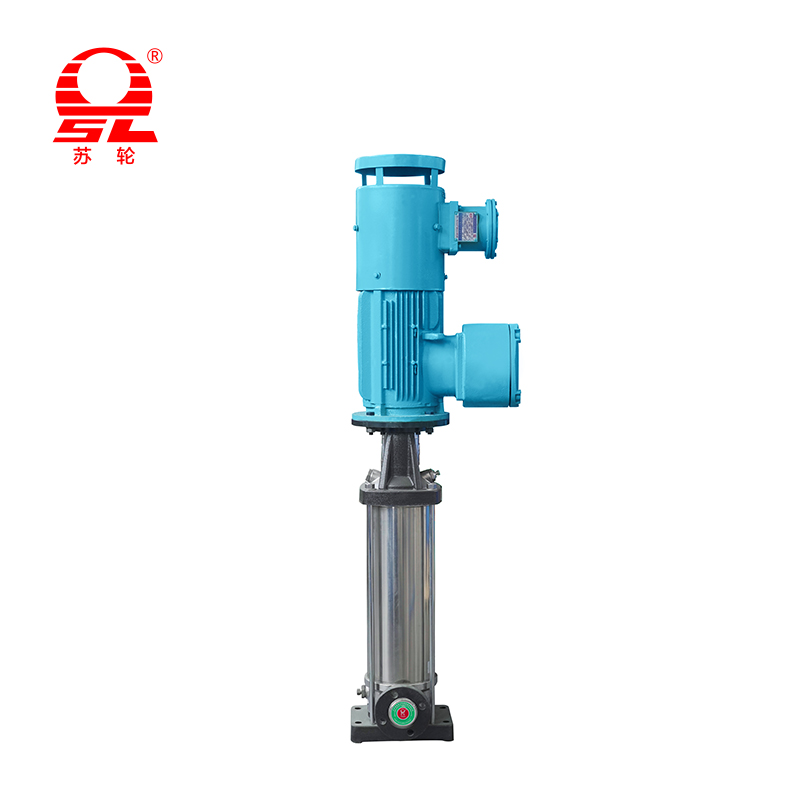
For vertical wet-well layouts, a multi-suction vertical sewage pump can reduce floor space and improve suction conditions in deep sumps. It is not a universal replacement for either design, but it can be a useful middle option where the station needs a vertical arrangement and better solids handling than a standard submersible sump pump.
 SLPWDL Multi-suction Vertical Sewage PumpVertical multi-suction sewage pump with large-channel impeller; useful in deep sumps where reduced floor space and solids handling are priorities.View Product →
In our works, the test platform covers pump diameters from Φ32 to Φ1200 mm, motor power from 1.1 to 1200 kW, and voltages from 380 V to 10 kV. That range matters because a sewage pump should be checked at the intended duty point, not only at a single nominal point. A factory performance test and a clear curve review can reveal whether the selected impeller trim, speed, and motor match the station.
Energy comparisons are often misleading when they compare only the pump efficiency at best point. Sewage pumps rarely operate at one fixed condition. Rain events, infiltration, variable inflow, and throttled discharge move the duty point. A pump with excellent peak efficiency can consume more energy if it operates far from that point for most of the year.
| Cost driver | Submersible station | Self-priming station | Procurement check |
|---|---|---|---|
| Civil works | Compact wet well and guide rail system. | Dry chamber, suction line, and access platform. | Compare total installed cost, not pump price alone. |
| Electrical protection | Seal monitoring, motor protection, and cable integrity are critical. | Motor is dry, but priming and seal protection still matter. | Confirm protection relays and control logic. |
| Maintenance labor | Lifting and wet-well access can add time and safety planning. | Dry access can shorten inspection, but suction-line work adds tasks. | Review local service capability and spare-parts plan. |
| Energy use | Low suction loss and good flooded-suction behavior. | Suction-line loss and priming time can reduce overall efficiency. | Compare wire-to-water efficiency at the actual duty range. |
| Downtime risk | Clogging and seal failure can require lifting. | Loss of prime and suction leaks can stop the pump without a mechanical failure. | Check alarm strategy and standby arrangement. |
A variable-frequency drive can improve part-load control for either design, but it does not correct a poor suction layout or an undersized suction pipe. The drive shifts the operating point; it does not remove air from the suction line. For self-priming pumps, the control sequence should include a priming period and a liquid-level check before the pump is allowed to run at full speed.
The right choice depends on the application, not on a preference for one pump type. The matrix below gives a starting point for discussion, after which the duty point and solids profile should be confirmed.
| Application | Likely first choice | Reason | Watch point |
|---|---|---|---|
| Municipal wet well with high inflow | Submersible sewage pump | Flooded suction, compact station, and wide flow range. | Guide rail, lifting access, and low-level control. |
| Retrofit with an existing dry chamber | Self-priming sewage pump | Dry motor access and suction lift can reuse the chamber. | Air-tight suction line and priming reliability. |
| Emergency flood drainage | Portable self-priming or submersible pump | Fast deployment and flexible suction arrangement. | Solids handling and power supply. |
| Industrial pretreatment with rags and fiber | Vortex submersible or trash-handling self-priming pump | Large passage and sweeping action reduce wrapping. | Efficiency penalty and impeller wear. |
| Deep sump with limited floor space | Vertical multi-suction or submersible pump | Vertical arrangement can reduce footprint and improve suction. | Lifting height and maintenance access. |
| Site with abrasive grit and variable flow | Wear-resistant submersible or heavy-duty self-priming pump | Material selection and passage design control wear. | Impeller clearance and wear-plate replacement. |
A sewage pump should leave the factory with more than a nameplate. The performance curve, impeller trim, seal arrangement, and motor protection should be checked against the agreed duty. For a station with variable inflow, the review should include the low-flow and high-flow ends of the curve, not only the design point.
Our two production bases cover nearly 60,000 m², with six modern production workshops, two assembly workshops, one dedicated test workshop, and more than 160 sets of machining equipment. The test platform is useful for large sewage and drainage projects because it allows the pump to be checked across the intended range rather than only at a catalog point. Collaboration with university fluid technology research teams also supports impeller and hydraulic development for different sewage and wastewater duties.
No. Submersible pumps are often better when the station has a wet well, flooded suction, and limited civil space. Self-priming pumps are often better when the motor must stay dry, the liquid must be lifted, or maintenance access is a priority.
Neither design is automatically better. Solids handling depends on the impeller, volute passage, and materials. A vortex submersible pump may handle rags well, while a trash-handling self-priming pump may handle larger debris. The solids profile should be matched to the actual passage.
It should not. The motor is dry, but the mechanical seal and priming chamber still need liquid. A dry run can damage the seal, raise temperature, and reduce priming reliability. Liquid-level control and a priming timer are basic protections.
Common causes include a leaking foot valve, air entering through a suction joint, a dry priming chamber, a worn seal, or a suction line that drains back after shutdown. Check the suction pipe before changing the pump.
No. They are designed to sit in the liquid, usually in a wet well with guide rails or a portable coupling. The station still needs a safe lifting arrangement and a control system that protects against low level and dry running.
There is no universal figure. The limit depends on the pump NPSH requirement, liquid temperature, altitude, suction-pipe friction, and the condition of the valves. A theoretical lift of 8 m is not a practical target if the line losses and NPSH margin are poor.
It depends on access and failure mode. A self-priming pump can be easier to inspect because the motor is dry. A submersible pump may have lower civil cost but higher lifting effort. Compare the cost of routine inspection, seal replacement, clog removal, and downtime for the actual station.
A vertical multi-suction or long-shaft arrangement can be useful in deep sumps where floor space is limited or where a vertical installation improves suction. It still needs a clear maintenance plan for lifting, shaft alignment, and bearing inspection.
Provide liquid type, temperature, pH, solids size and fiber content, flow range, head, suction layout, voltage, frequency, control method, installation depth, and available maintenance access. A quotation based only on flow and head is likely to miss the real selection risk.
Match the impeller to the solids, maintain enough velocity in the discharge line, avoid low-flow settling, use a suitable control sequence, and provide access for inspection. A larger pump does not always reduce clogging; the passage and impeller shape matter more.

+86-0523- 84351 090 /+86-180 0142 8659


Add 1: Hongguang Industrial Park, Jingjiang City, Jiangsu Province, China
Add 2: No.68, Xinyi Road, Industrial Park, Jingjiang City, Jiangsu Province, China
+86-0523- 84351 090
+86-180 0142 8659
+0523-8435 5588